Across the thirteen years that USC’s Annenberg Inclusion Initiative has audited the credits on the world’s biggest songs, 93.3% of them were made without a single woman producer. Not a low share of women producers. None at all, on more than nine in ten hits.
That is the sharpest way into a question that comes up most years, usually around International Women’s Day: where are all the female music producers? Women are about half of the people who study music, and a rising share of the artists and songwriters behind the hits. But at the producer’s chair – the person shaping how a record actually sounds – they all but disappear.
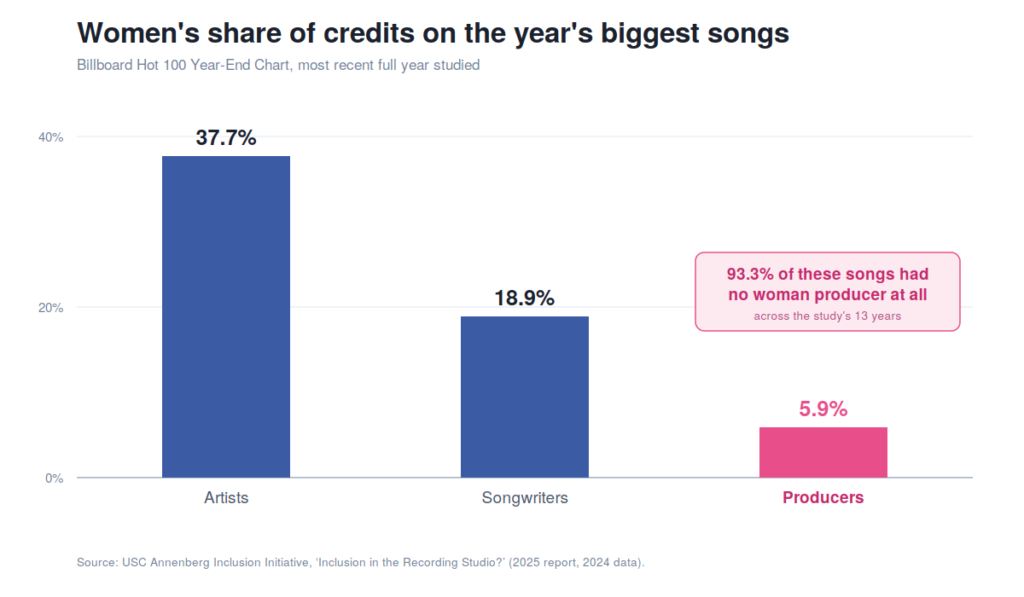
The most recent full year USC examined makes the gap plain. Women were 37.7% of the charting artists, 18.9% of the credited songwriters, and 5.9% of the producers. Put another way: nearly two in five of the artists, but fewer than one in seventeen of the producers.
The same gap, wherever you measure it
The exact number depends on what you count, but the shape holds everywhere. In the UK, the Musicians’ Census found women were around 24% of people working as producers, 15% of live sound engineers and 12% of studio and mastering engineers – the roles thinning out the further behind the glass you go. Across the professional audio workforce as a whole, organisations such as SoundGirls have long cited a figure closer to 5%.
Australia looks much the same. The Music Producer and Engineers’ Guild of Australia ran its first national survey in 2023 and found women were 11.3% of members, with a further 1.9% non-binary. The Australian Bureau of Statistics, counting sound technicians at the 2021 Census, puts women at about 9%. Non-binary producers barely register in any of these counts, which belongs in the same story: the doors that stay shut to women tend to stay shut to anyone who isn’t a man.
It starts before anyone reaches the industry. Enrolment in audio and music-technology courses skews heavily male – individual programmes report women at well under a third of students, and some recording-arts intakes far lower. Those are examples rather than national averages, but they point the same way: the imbalance is already there in the classroom.
Where it’s moving, and where it isn’t
It isn’t uniformly bleak. The same USC data shows real movement in some roles: women were 11% of credited songwriters in 2012 and 18.9% by 2024, and the share of women artists has climbed over the same stretch. Production is the part that has barely shifted – women producers went from 2.4% in 2012 to about 6% now, a decade of near-flatness.
There’s a genre wrinkle worth flagging, too. Women songwriters are most represented in pop and in dance and electronic music, and least in hip-hop and country. The electronic end of the spectrum, in other words, is where the balance is least bad – which turns out to matter for what follows.
Why the drop-off happens
The convenient explanation is that women simply prefer performing to producing. The numbers don’t support it, and neither does the experience of most people who teach this for a living. The fall-off tracks visibility more than interest: who is pictured at the desk, who stands at the front of the class, who was made to feel the studio was theirs early enough to believe it. One respondent to the Australian guild’s survey put it in four words – you can be what you see.
There’s also evidence the number moves when someone sets out to move it. Where institutions and funding bodies have deliberately targeted women for technical roles, the share has risen. Left alone, it tends to stay where it is.
A case study: one Sydney school
Liveschool, a music production school in Surry Hills, is a small, concrete example of what changing the number looks like up close – including how easily it goes wrong when nobody is watching for it.
In 2013 the school rebuilt its website. The music-tech look of the day was uniform: black backgrounds, neon, a man at a machine. The school went the other way on purpose, with a white background and blue and pink throughout. But every course page carried a photo – a hand on a synth, a hand on a console – and every hand belonged to the same male staff member, who also happened to be taking the pictures. Nobody had decided to do that. The result was still a site that pictured every course as something men did. The lesson stuck: exclusion is usually unplanned, sitting in small defaults nobody thought to check.
What followed ran over roughly a decade and moved through three places in turn. First the imagery, so that what people saw of the school was no longer uniformly male. Then the stage: through its INPUT masterclass series, the school worked to balance who was teaching in public, bringing in producers such as Kučka and Catlips, now Roza Terenzi. Then the classroom itself, hiring artists including Ninajirachi, Kučka, Brux and Made In Paris – now PARIS – as trainers. Some were established and some were early in their careers, which made it as much a development programme as a hiring round.
The intake numbers followed. From a low base in 2013, the school reached about 35% women by 2016 and about 45% by 2018, and has held between there and roughly half ever since.
Most audio and production courses run heavily male. This one’s intake has sat near half for most of a decade.
That figure needs an honest caveat. Classes are capped at ten and cohorts are small, so any single intake can land well above or below the average. It is a sustained number across many groups, not a promise about any one of them.
What it looks like in practice
The clearest evidence isn’t the percentage, it’s the alumni – and they sit in an interesting pattern. Rather than cluster in the middle, the women and gender-diverse producers who have come through tend to gather at the two far ends of the spectrum: the hard, physical end of club music, and the intimate, song-led end. Both ends, notably, sit in or near electronic music – the genre the data says is least lopsided to begin with.
The club end
Ninajirachi builds dense, detailed electronic music where the production carries the track. Logic1000, raised in Sydney and now working overseas, makes club music out of UK garage and bass. Nina Las Vegas runs NLV Records and has been a fixture of Australian dance music for years. Roza Terenzi releases house, breaks and electro on her own Step Ball Chain label, and PARIS works the techno end.
The song end
Sir Jude is a self-producing alt-pop artist whose work circles female agency and selfhood. Kučka is a producer and vocalist whose experimental pop has travelled well beyond Australia. Montaigne (they/them), included here as part of the school’s gender-diverse community rather than under the women heading, makes art-pop built around song and voice.
The spread is its own answer to the lazy version of the question. The hardest dance music and the most delicate songwriting, both coming from the group the industry keeps describing as scarce.
You can hear the full set on the Women Producers of the Liveschool community playlist, and several of these artists are covered in more depth in a related piece on women in electronic music at Liveschool.
What the numbers actually show
So, where are the female music producers? Most were filtered out long before the studio, by a pipeline that loses women at nearly every stage from the classroom to the credit. That much the data settles.
The part the data also shows, quietly, is that the filtering isn’t fixed. One school’s intake is a small sample, but it points the same way as the funding-body evidence: when the defaults get changed on purpose, the share moves. The shortage is real, but it is made, not given – which means it can be unmade.
Liveschool teaches music production in person in Sydney, in small groups. Course details are on the course pages.