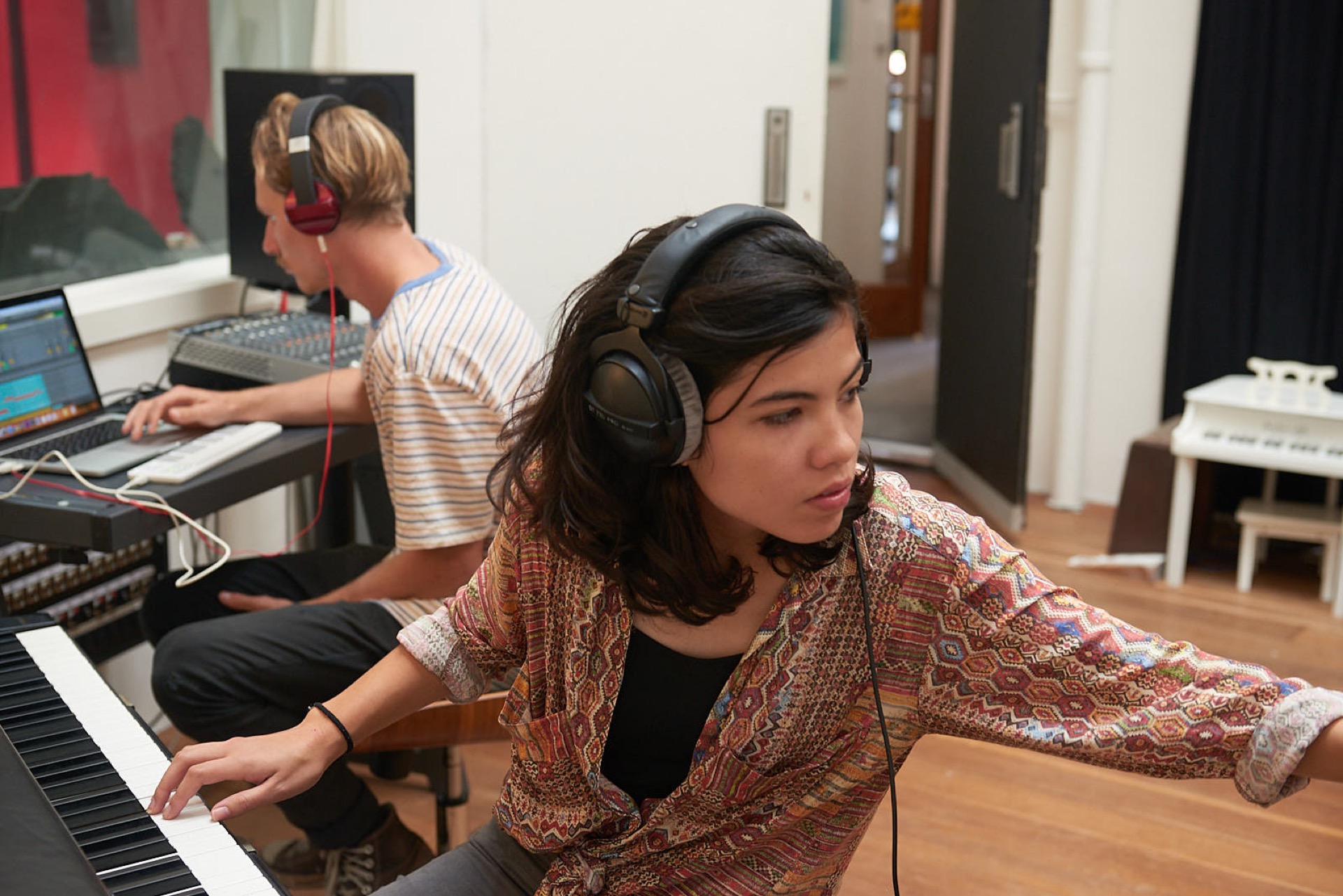
Write stronger melodies, chord progressions, and basslines that bring your tracks to life.
Music Theory is for producers who want practical composition tools they can apply directly inside Ableton Live.
You’ll learn melody writing, chord voicings, harmonic movement, bassline construction, and key relationships through modern production techniques — not traditional conservatorium theory.
Classes focus on writing stronger musical ideas, while mentor weeks help you apply those concepts to your own tracks with personal guidance from an experienced producer.
Trainers and Mentors on this course:




What You’ll Learn
Melody writing
Write stronger, more memorable melodies using interval relationships, phrasing, repetition, and variation.
Chord progressions
Build effective progressions using diatonic harmony, borrowed chords, inversions, and modern voicings used across electronic, pop, and R&B production.
Bassline construction
Create basslines that support harmonic movement, lock in with your drums, and add direction to your tracks.
Key and scale fluency
Work confidently with keys, modes, and scales so you can find the right tonality for an idea without guesswork.
Harmonic analysis
Understand why the tracks you love work — tension, release, movement, and emotion — then apply those principles to your own music.
Theory inside Ableton Live
Apply every concept directly in Ableton’s piano roll and MIDI tools, turning theory into practical composition and arrangement decisions.
How It Works
Attendance
Choose from either in-studio (Sydney) or online. Switch between in-studio and online any time.
Duration
Part-time: 4 weeks of classes + 3 weeks mentoring.
Full-time: 1 week of fast-tracked classes followed by 4 weeks of remote mentoring.
Format
Take Music Theory as a stand-alone module, or as part of Produce Music or Focus Series.
Classes + Mentoring
Learn core composition concepts in small classes, then apply them to your own tracks during dedicated 1:1 mentor weeks.
Pricing
$1,756 AUD
Instalment plans available from $620/month over 3 monthly payments.
Choose a Start Date


Who This Module Is For
This module is for producers who are comfortable in Ableton Live and can build beats and arrange basic ideas, but want to strengthen their compositional skills — writing better melodies, more interesting chord progressions, and basslines that support the track.
If you’ve completed Liveschool’s Foundations module (included in Produce Music), you’re well prepared. If you’re coming from outside Liveschool with equivalent Ableton skills and some basic theory, get in touch and we’ll help you assess the right starting point.
FAQs
To enrol in Music Theory, you should meet one of the following criteria:
- Completion of the Foundations module (included in Produce Music).
- Equivalent Ableton Live and music production skills, as covered in Foundations.
You should already be comfortable with MIDI programming, audio editing, and building simple tracks. If you’re unsure, get in touch and we’ll help you assess whether this is the right starting point.
Just two things are required:
- A copy of Ableton Live Suite. If you’ve been sharing a licence, you can access a free 30-day trial to get started, and when you’re ready to purchase, you’ll receive a 50% discount.
- A standard pair of wired headphones (not Bluetooth-only).
A laptop is useful, but if you only have a desktop, we can provide a laptop on-site.
We offer flexible options:
- Switch to an online session if you can’t attend in person.
- Access detailed study resources at home if you miss a session. Discounted one-to-one catch-up sessions are also available.
- If you miss the full module, you can join a waitlist to retake it later.
You can take Music Theory either as a stand-alone module or as part of Produce Music or the Focus Series. The core teaching and mentorship are the same either way.
No. This module teaches music theory through Ableton Live’s piano roll and MIDI tools — not traditional notation. If you can hear the difference between a happy and sad chord, you have enough to start.
You’ll be able to write stronger melodies, more effective chord progressions, and basslines that better support your tracks. Most students leave with practical composition tools they use immediately in their productions.